DIAGNOSING CANCER.
Many signs indicate the onset of cancer, among them, changes in the size, color, or shape of a wart or a mole; a sore that does not heal; or persistent cough, hoarseness, or sore throat. Many other diseases can produce similar symptoms, however, and for this reason it is important for a person to visit a doctor for regular checkups and diagnosis. Usually, diagnosis calls for fairly routine physical examination, though in the case of cancers of the reproductive organs, “routine” can still be plenty invasive.
Doctors examining women for cancers of the ovaries, uterus, cervix, and vagina must palpate the internal organs—that is, examine them by touch. For males, inspection of the rectum and the prostate is included in the physical examination. The doctor inserts a gloved finger into the rectum and rotates it slowly to feel for any growths, tumors, or other abnormalities. The doctor also palpates the testicles to identify any lumps, thickening, or differences in the size, weight, or firmness. Such examinations, as well as diagnoses for certain other types of cancer in private parts (namely, colon cancer), can be less than pleasant, but they are certainly preferable to an early and painful death.
If the patient has an abnormality that could be indicative of cancer, the doctor may order diagnostic tests. These tests may include laboratory studies of sputum or saliva, blood, urine, and stool (feces). To locate tumors, such imaging tests
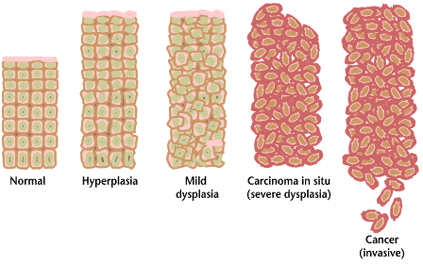
as computerized tomography (CT) scans, magnetic resonance imaging (MRI), ultrasound, or fiber-optic scope examinations may be used. The most definitive diagnostic test, however, is the biopsy, in which a piece of tissue is surgically removed for examination under a microscope.
Besides confirming whether a patient has cancer, the biopsy also provides information about the type of cancer, the stage it has reached, the aggressiveness
of the cancer, and the extent of its spread.
Screening examinations, conducted regularly by health care professionals, can result in the detection of cancers at an early stage. In addition, advances in molecular biology (an area of biology concerned with the physical and chemical
basis of living matter) and cancer genetics have led to the development of several tests for assessing one’s risk of developing cancers. These new techniques include genetic testing, in which molecular probes are used to identify mutations in certain genes that have been linked to particular cancers. At present, however, there are limitations to genetic testing, a fact that emphasizes the need for better strategies of early detection.
Doctors examining women for cancers of the ovaries, uterus, cervix, and vagina must palpate the internal organs—that is, examine them by touch. For males, inspection of the rectum and the prostate is included in the physical examination. The doctor inserts a gloved finger into the rectum and rotates it slowly to feel for any growths, tumors, or other abnormalities. The doctor also palpates the testicles to identify any lumps, thickening, or differences in the size, weight, or firmness. Such examinations, as well as diagnoses for certain other types of cancer in private parts (namely, colon cancer), can be less than pleasant, but they are certainly preferable to an early and painful death.
If the patient has an abnormality that could be indicative of cancer, the doctor may order diagnostic tests. These tests may include laboratory studies of sputum or saliva, blood, urine, and stool (feces). To locate tumors, such imaging tests
as computerized tomography (CT) scans, magnetic resonance imaging (MRI), ultrasound, or fiber-optic scope examinations may be used. The most definitive diagnostic test, however, is the biopsy, in which a piece of tissue is surgically removed for examination under a microscope.
Besides confirming whether a patient has cancer, the biopsy also provides information about the type of cancer, the stage it has reached, the aggressiveness
of the cancer, and the extent of its spread.
Screening examinations, conducted regularly by health care professionals, can result in the detection of cancers at an early stage. In addition, advances in molecular biology (an area of biology concerned with the physical and chemical
basis of living matter) and cancer genetics have led to the development of several tests for assessing one’s risk of developing cancers. These new techniques include genetic testing, in which molecular probes are used to identify mutations in certain genes that have been linked to particular cancers. At present, however, there are limitations to genetic testing, a fact that emphasizes the need for better strategies of early detection.


 Posts
Posts